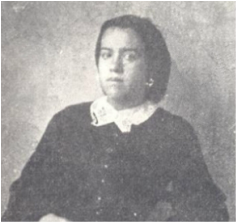
Berlin's French Canadians According to the 2010 census, 5,792 out of Berlin’s 10,126 people are of some sort of French ancestry. This is 57% of Berlin’s population. A question arises.....
|
Early History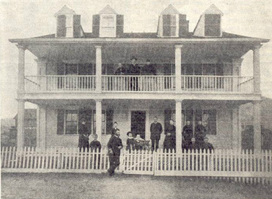
In 1771, land was surveyed under the orders of Governor John Wentworth. The township of Maynesboro, also spelled Maynesborough, started at a spruce tree at the southeast corner.....
|
The "Hairy Hand" Case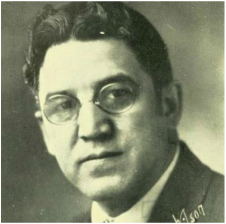
At the age of 11, George A. Hawkins received a thin pencil-sized electrical burn after turning on the kitchen light.....
|
Berlin, New Hampshire History Paper City, The City That Trees Built, and Hockey Town USA were all names given to our city back in its heyday. Situated on the Androscoggin River, Berlin once was the center of the pulp and paper-making industry, once having a population over 20,000 people that came from all over the world. Great Britain, Canada, Russia, Scandinavia, and Germany were all places where our ancestors came from and they choose to settle in our city. Some of the old timers still recall going down town to shop and meet up with friends and family on
Sunday. Industry and a lot of hard work is how our city was founded and it is still in the hearts of most of the residents of Berlin today. No matter what profession they were in, a teacher or a logger, a doctor or a mill man, they all played a huge part in this city’s history and they still do. Our city has come a long ways since it was first granted on December 31, 1771 by Colonial Governor John Wentworth as the small village, named Maynesborough, after a man by the name of Sir William Mayne from London, England. Maynesboro was first settled in 1824 by William Sessions and Cyrus Wheeler. The small township was later incorporated as the town of Berlin with the help of Thomas Wheeler, who was also the father of Cyrus. With only 65 inhabitants, most of them from Shelburne, New Hampshire and Gilead, Maine, Berlin was in the farming industry. It was known early on to the residents of Berlin, that is situated in a heavily forested region, was a great place for logging and wood industries. The falls on the Androscoggin River provided water power for the future sawmills that were to be built in Berlin. In 1851 the St. Lawrence & Atlantic Railroad, later changing its name to Grand Trunk, entered Berlin. The chance to build a saw mill in Berlin came in 1852 when a group of Portland, Maine businessmen, John B. Brown, Josiah S. Little, Nathan Winslow and Hezekiah Winslow, recognized that the construction of the railroad line through Berlin was a great way to import and export wood products in and out of town. Acquiring water, timber and rail rights, they formed a partnership under the name H. Winslow & Company, which changed its name to Berlin Mills Company in 1868, and they built a large sawmill at the head of Berlin Falls. John Brown ended up selling his stock to William Wentworth Brown also of Portland, Maine but they were not related in any way. Brown and his family members purchased the remaining stock and acquired complete control of the Berlin Mills Company and changed the name to Brown Company during World War I. Berlin also had other industries including the Forest Fiber Company, the first chemical pulp mill in Berlin, which
operated until the 1890’s, and the International Paper Company. The largest of the mills by far was the Brown Company that owned land stretching from Canada to Florida and employing more than 9,000 men. The Brown Company also appeared to have avoided economic disaster in the early 1930’s but the company was forced into bankruptcy near the end of World War II. The Brown family lost its remaining interest in Brown Company, and it was sold to outside investors that continued reducing its staff and finally closing its doors in the 1980's. Without the Browns, the pulp and paper mills continued to decline under a series of out-of-state corporate owners, until the last owner, Fraser Paper, finally closed the Berlin pulp mill in 2006 and sold it to American Dismantling. Berlin has been through a lot of changes throughout its lifetime and still continues to shape its history as the days go by. Who knows what type of businesses will be in Berlin in the next twenty years. |
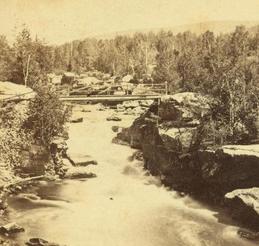
Berlin Falls (Image from New York Public Library)
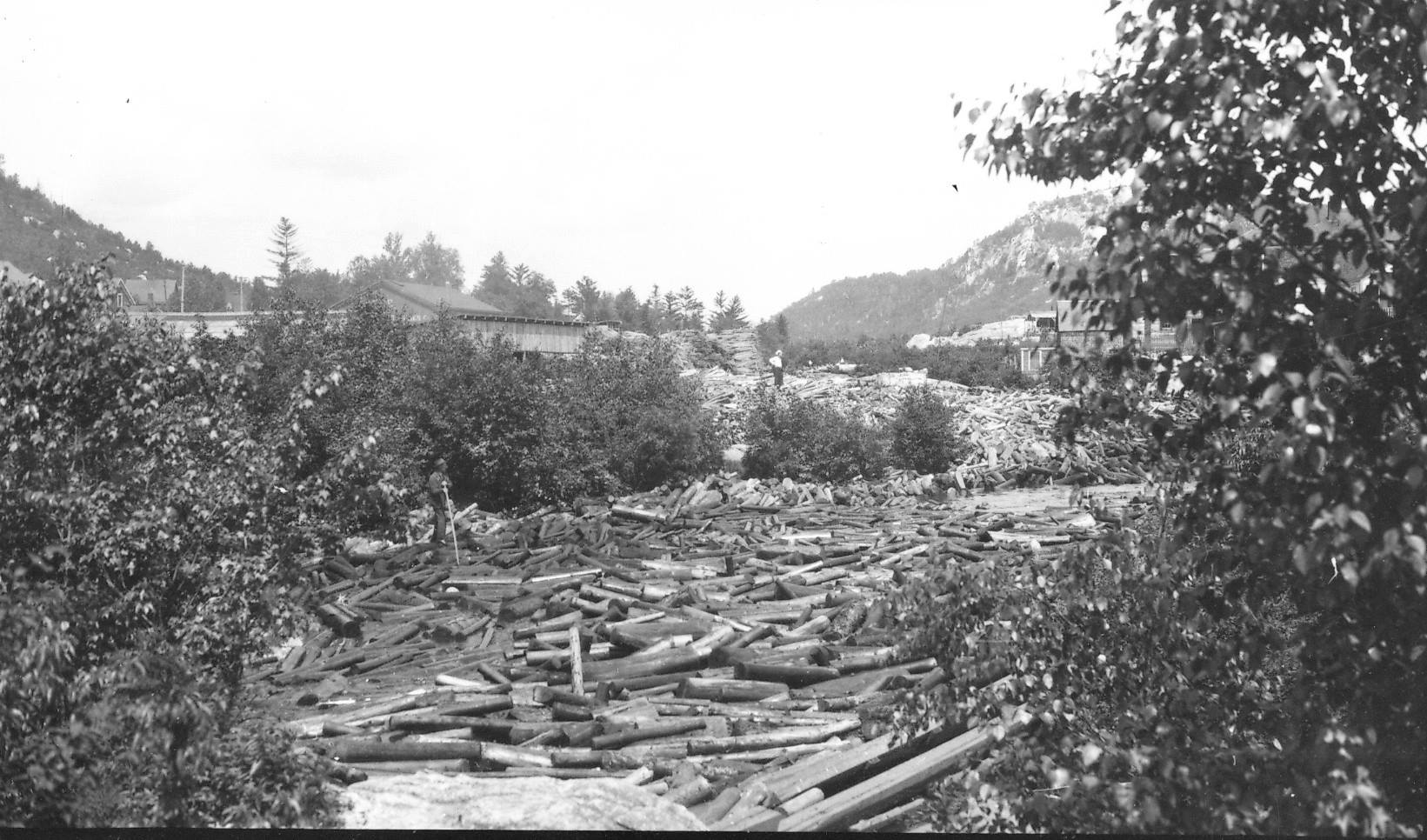
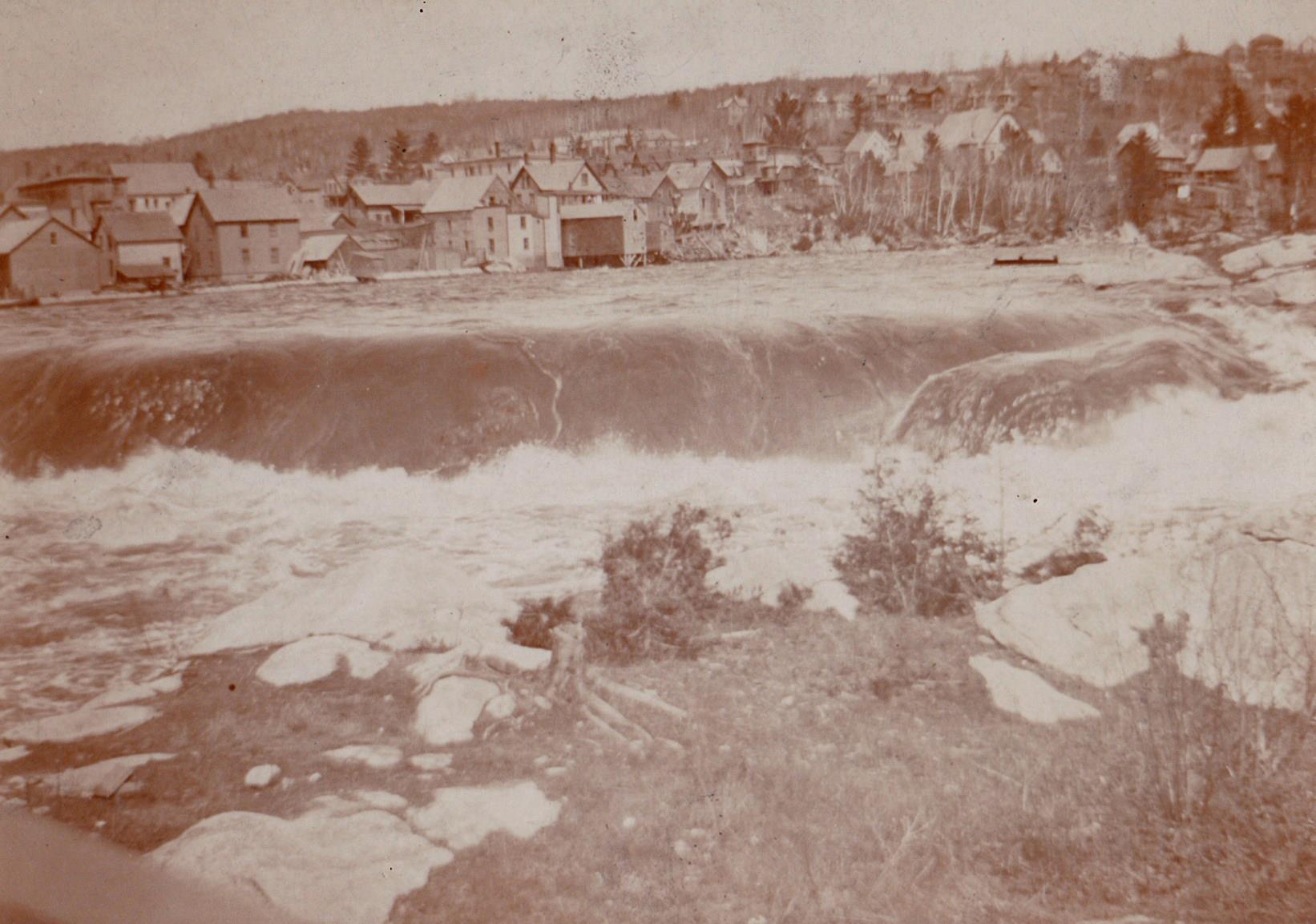
Note: Although the above files say "Download File" it does not download onto your computer, rather takes you to another page downloaded to this website. | ||||||

Current Age of Berlin
have past since the granting of Maynesborough on December 31, 1771.
have past since the incorporation of Maynesborough as Berlin on July 1, 1829.
have past since 1897, the year Berlin became a city.
have past since the incorporation of Maynesborough as Berlin on July 1, 1829.
have past since 1897, the year Berlin became a city.
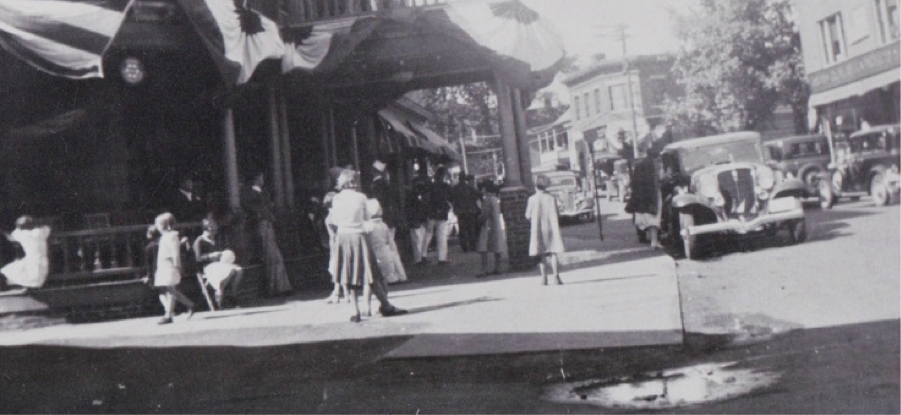
In front of the New Revere House (Dunkin Donuts) in the 1920's. Image from Poof Tardiff.
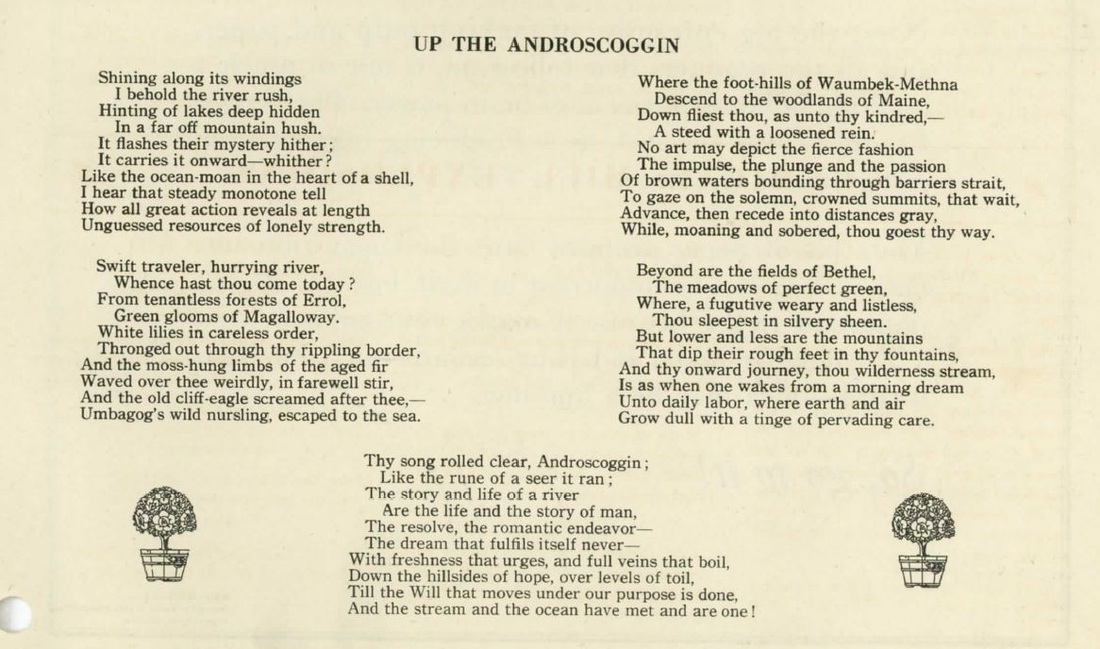
Lucy Larcom wrote this poem at Berlin Falls in September of 1878
Past vs. Present
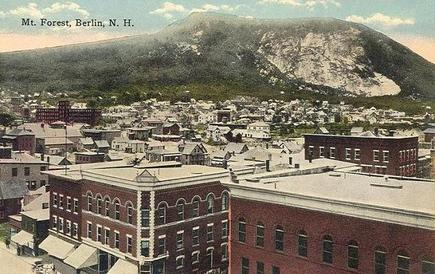
View from atop Albert Theater, around 1914 (Image from Poof Tardiff).
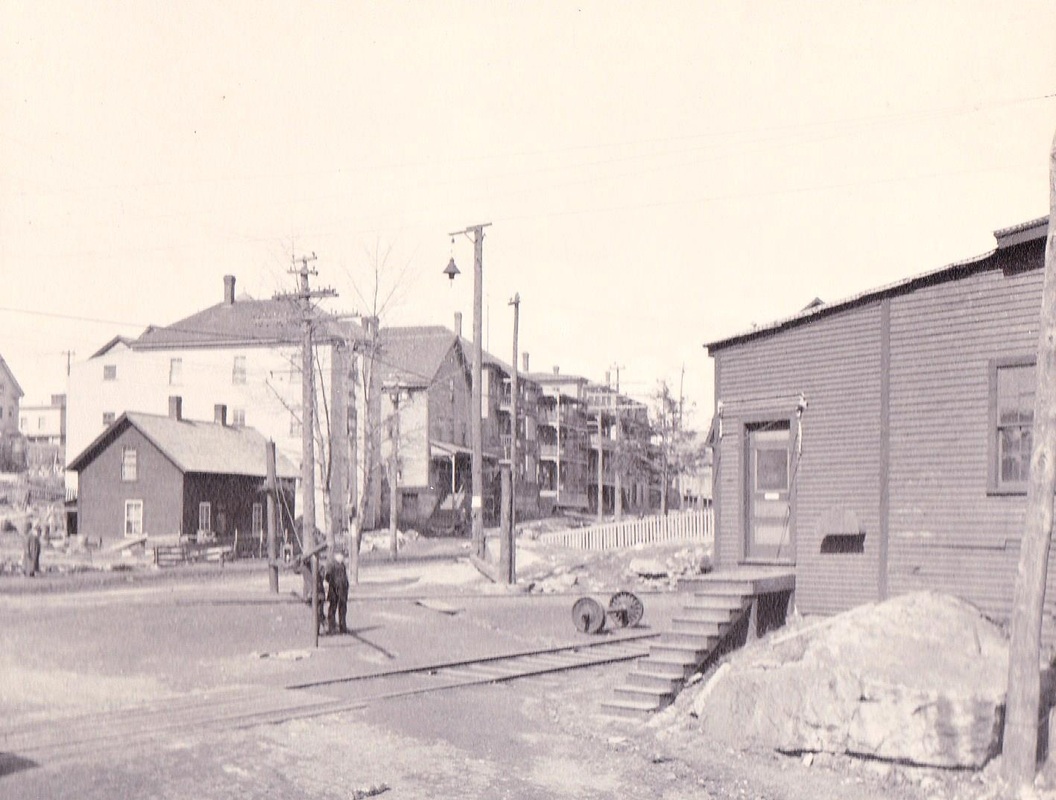
This photo was taken in 1905. The rail road tracks went from International Paper Mill and connected to the Grand Trunk. (Image from Poof Tardiff).
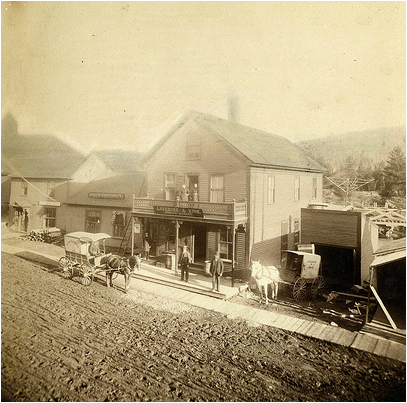
Lefebvre and King store on Main Street, late 1880s.
|
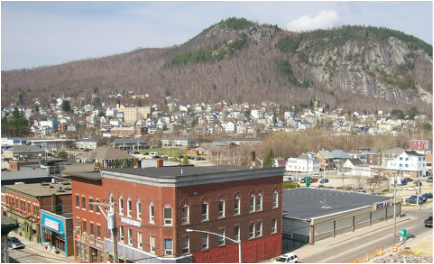
View from atop Albert Theater, 2012 (Image from Poof Tardiff).
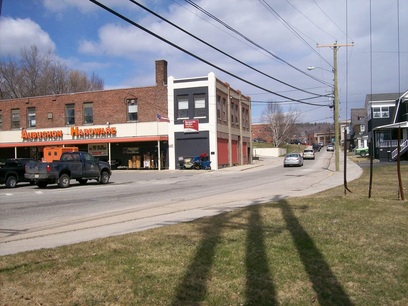
This photo was taken around the same area as the photo on the left. One can still see the remains of the tracks, if they look carefully just above the IGA parking lot.
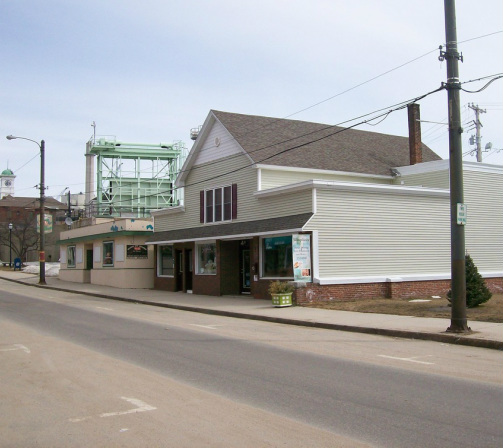
Lefebvre and King store (Skinplicity), 2013
|
Berlin, New Hampshire - Moving Images of the Past
Berlin's First Automobile
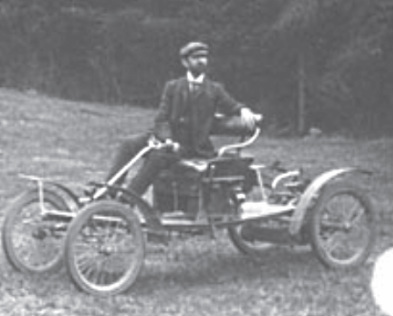
Berlin's first car (Image from Poof Tardiff)
T. P. Burgess’ new car arrived in Berlin on Wednesday, May 22, 1901. When Mr. Burgess got his car there were still horses and buggies roaming the streets. The car had the name of its creators, Dedion-Bouton Motorette Company of Brooklyn and New York, stamped on it. The car was a rich red with dark trimmings and everyone was excited to see what it looked like when it got off the Boston and Maine railroad but unfortunately Mr. Burgess was not home when the car arrived. When Mr. Burgess came back to town he took the car out and gave it a test ride.
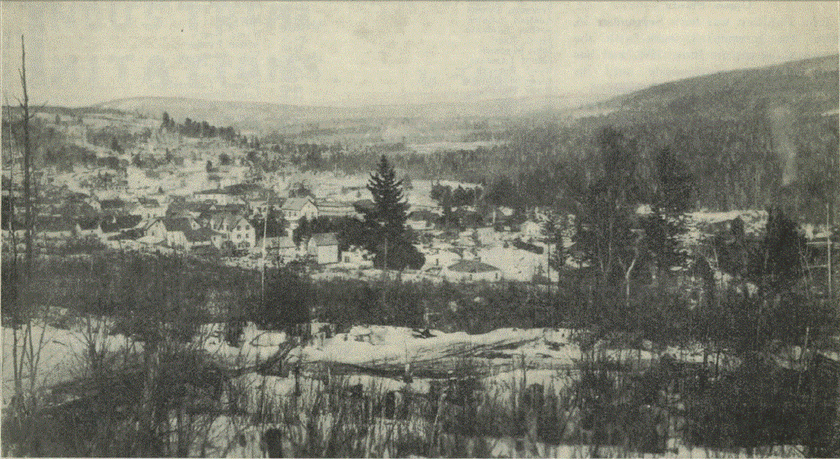
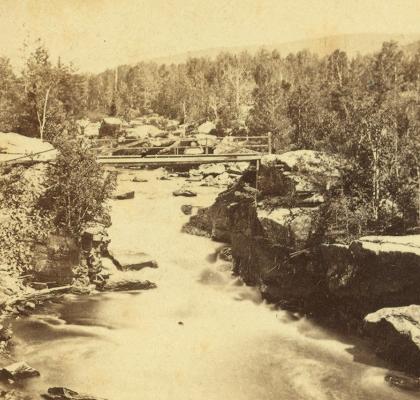
This photo is from the Brown Bulletin, June of 1929. This photo is of “Berlin Falls” in the late 1870's.
About Berlin, New Hampshire
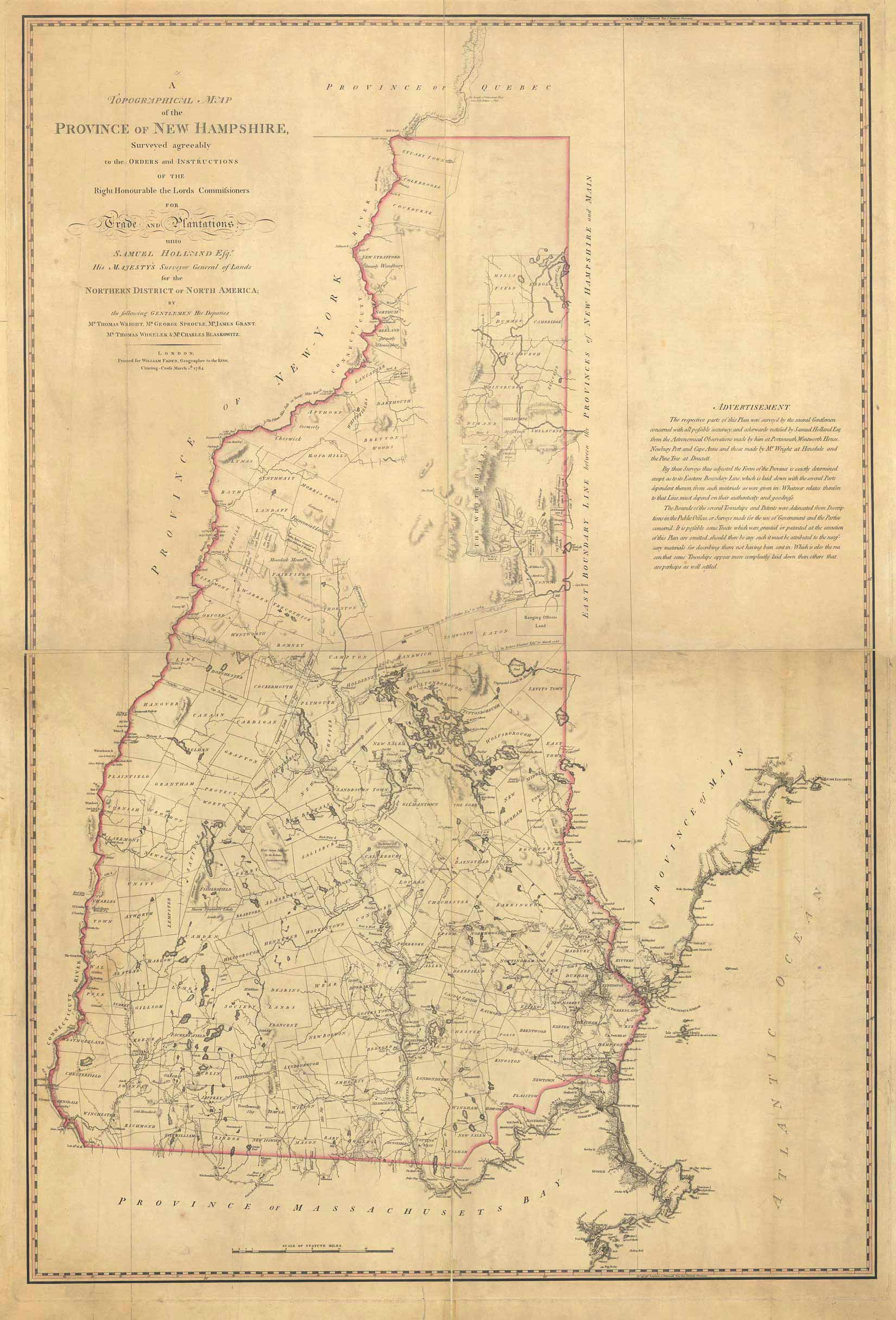
A map of New Hampshire in 1784 (click image to see full size)
The city of Berlin borders the towns of Milan, Randolph, Gorham, Kilkenny, and Success. The pronunciation of Berlin was changed to BUR-lin, instead of Ber-LIN (as in Berlin, Germany), during World War I as a patriotic stand against Germany. The name Berlin itself comes from the Old Polabian (West Slavic) word, Berl-lbirl, meaning "bog" or "swamp". This is not the reason why the early settlers of Maynesborough chose it, that question is completely unknown, despite the rumors that one of the early founders came from Berlin, Mass.
In 2009 there were around 4,896 females and 4,455 males and altogether there were 9,351 people living in Berlin. The average age of the people living in Berlin at that time was around 42 years old. The estimated median household income also of that same year was around $38,626 a year. There is around a -9.5% population change from 2000-2009.
The height of Berlin’s population was recorded in the year 1930 which was 20,018 people. There is a huge change in Berlin’s population from the years 1830-1930 because in the year 1830 there were only 73 people (3 families) living in Berlin. The huge growth was thanks to the pulp and paper industries that were built here. Now that the mills in Berlin have closed, we have seen a loss of population but we cannot forget our history. At one point in time, wherever there was paper in the country people knew the name of Berlin, New Hampshire and that’s no overstatement. Berlin was so famous that in 1929, the movie "The Masked Menace" was filmed in Berlin, but since then the movie has been considered to be "lost". Maybe someday we can redeem ourselves and everyone in the United States will know our name again.
In 2009 there were around 4,896 females and 4,455 males and altogether there were 9,351 people living in Berlin. The average age of the people living in Berlin at that time was around 42 years old. The estimated median household income also of that same year was around $38,626 a year. There is around a -9.5% population change from 2000-2009.
The height of Berlin’s population was recorded in the year 1930 which was 20,018 people. There is a huge change in Berlin’s population from the years 1830-1930 because in the year 1830 there were only 73 people (3 families) living in Berlin. The huge growth was thanks to the pulp and paper industries that were built here. Now that the mills in Berlin have closed, we have seen a loss of population but we cannot forget our history. At one point in time, wherever there was paper in the country people knew the name of Berlin, New Hampshire and that’s no overstatement. Berlin was so famous that in 1929, the movie "The Masked Menace" was filmed in Berlin, but since then the movie has been considered to be "lost". Maybe someday we can redeem ourselves and everyone in the United States will know our name again.
Towns that Border Berlin
Milan, New Hampshire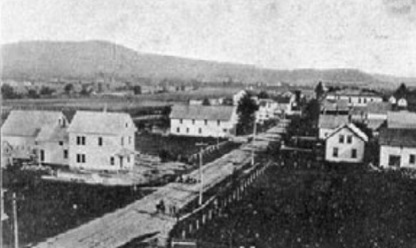 An early photograph of one of the towns that borders Berlin, Milan, originally called Paulsburg. This town was incorporated as Milan on December 16, 1824. Some of the original settlers of Milan include the last names of Ellingwood, Hodgdon, Fogg, Hinds, Roberts, Hagar, Sargent, Nay, Twitchell, and Newell. (Image from Poof Tardiff) {Click Photo For More Info.} Randolph, New Hampshire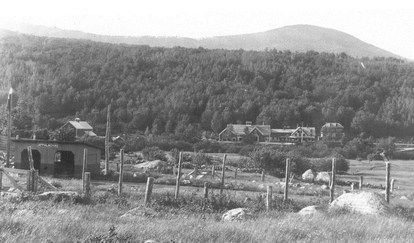 A photo of the Ravine House which once stood in a town that borders Berlin, Randolph. The Ravine House (center right) in 1876 was converted from a farm to a summer boarding house by Abel Watson and his son Laban. This building helped the growth of Randolph (since 1824) originally called Durand. The Ravine House closed in 1960 and was razed in 1963. |
Gorham, New Hampshire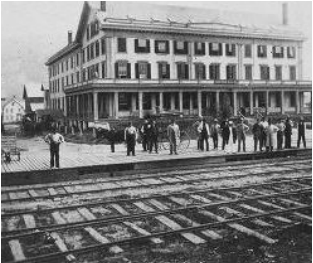 An early photo of a town that borders Berlin, Gorham, originally called Shelburne Addition and incorporated as Gorham in 1836. This photo shows the the Alpine House, which stood where the tennis court is today. {Click Photo For More Info.} Kilkenny, New Hampshire Berlin also borders a town which, according to the 2010 census, has no inhabitants. That town is Kilkenny which was granted on June 4, 1774 after the city and county of Kilkenny, Ireland. In 1856, Kilkenny had 19 inhabitants.
Success, New Hampshire Success was granted in 1773 and contained about 90,472 acres. The grantees were Benjamin Mackay and about seventy others. The state of New Hampshire requires a nearby incorporated town to exercise the responsibilities that would fall to the Town of Success if it should be incorporated. Some towns in the state bearing such responsibility have sought to be relieved of it.
|
